


How does GPT-4 surpass GPT-3.5 in creative content generation?
- GPT-4 has shown better comprehension of the prospective thus the text produced is more accurate and subtle.
- GPT-4 features show a better understanding of natural language and facilitate improved quality versions good for creative content.
- The innovative training data and advanced ideas produced by GPT-4 result in the creation of advanced content.
- Moreover, GPT-4 leads to better accuracy hence resulting in less alteration in content creation procedure.
- GPT-4 can evaluate large volumes of data thus enabling diversity across different formats and companies.
Creative Content Generation

Open AI established GPT-3.5 vs GPT-4 as LLMs based on a neural design known as Generative Pre-trained Transformers (GPT). They are both proficient in huge datasets of writing and programs.
Comparing GPT-3.5 vs GPT-4, many consider GPT-4 better in terms of intricacy, imagination, and adaptability. In this article, we will compare and contrast GPT-3.5 vs GPT-4 and how they help to create innovative content.
GPT-3.5 vs GPT-4 Improved Natural Language Processing
Capability to recognize context
Many consider GPT-4 to be much more significant in understanding context. Whereas, GPT-3.5 can understand coarse context while GPT-4 can comprehend context as well as the various tones.
This capability enables GPT-4 to permit the model to provide more topic-coherent output over large passages. It keeps the model relevant to the user’s intended thematic directives.
For example, GPT-4 can separate the topics according to the subjects while giving a formal answer in a detailed context.
Better language articulacy
GPT-4 is possibly smarter than GPT-3.5 due to flexibility in the flow of languages. The textual outputs are not only correct in grammar but contain intricate styles in writing. This model incorporates a higher degree of lexicon and uses a wider callus of constructions; the result is writing that is not only correct but also engaging and varied.
Moreover, the key improvement is fluency in writing, which is helpful in creative writing. It is also pertinent to note that the constructed sentences with GPT-4 are smoother and logically connected.
GPT-3.5 vs GPT-4 Creative Content Generation Features
Enhanced storytelling capabilities
GPT-4 enhances storytelling features, providing detailed and interesting content. Comparing GPT-3.5 vs GPT-4, GPT-4 has the incredible power to populate its stories with very subtle characters. It also creates an actual plot that would give the readers an adrenaline rush from the beginning to the end.
Furthermore, it can handle multiple arcs of a plot that can sub-plot does not make it forget the other parts. This makes GPT-4 very useful to writers; marketers and content developers who often build interesting stories that would help them attract the attention of the audience.
GPT-3.5 vs GPT-4 Better creativity and originality
The main difference established by GPT-3.5 vs GPT-4 is that GPT-4 can create new work or unique ideas. This is exemplified in the analytical functions, the creativity meetings, and the generating concepts.
Enhanced coherence and flow
In connection with inductive pre-trained models, the organization of structures and content, the orderliness of GPT-4 is much better than that of GPT-3.5. The newer model is the better one in terms of maintaining and preserving the logical chronology.
This is critical when it comes to producing and creating the good and rather interesting articles. It is such coordination that allows all components in the text under discussion to meet the overall logic.
In addition, many argue that the benefits of better flow lie not only in making the text easier to peruse but also in sustaining the reader’s interest in long texts, which is important in educational, official, research, or professional communication.
Comparison: GPT-3.5 vs. GPT-4 in Creative Content Generation
Presentation Metrics
When comparing GPT-3.5 vs GPT-4, we must relate other input-decoding metrics. These key performance metrics demonstrate substantial improvements in GPT-4. First of all, the level of precision in delivering an actionable understanding of the text and generating an adequate response has been enhanced considerably in the upgraded GPT-4 model. Compared to that, GPT 3.5 is inclined to misunderstand question intents.
Next, response time has also turned out to be another variable known to have improved over the years. GPT-4 prompts are elicited quickly, which could result from better algorithm improvement and more efficient leveraging of the enhanced architecture.
Likewise, GPT-4 has a better understanding of the need for the task, as well as its capabilities of searching for data from a higher number of semantically related sources and contexts, which in turn provides more meaningful and profound answers to questions.
User Feedback
The feedback from the users is further indication that there is improvement in terms of more smooth and memorable performance of GPT-4 in creating content. Operators indicate a positive experience because GPT-4 increases in orderliness and relevance of the produced materials particularly when engaging in creative work for instance in fiction or poetry.
Furthermore, it is also lauded upon returning the results that GPT-4 had a relatively lower probability of zero or low repetition of ‘copied’ or ‘pointless’ text compared to GPT-3. 5. The developers, content creators, and the common end users always have a higher satisfaction rate when it comes to the upgrades of the specific GPT-4.
GPT-3.5 vs GPT-4 Potential Applications of Content Creation in Various Industries
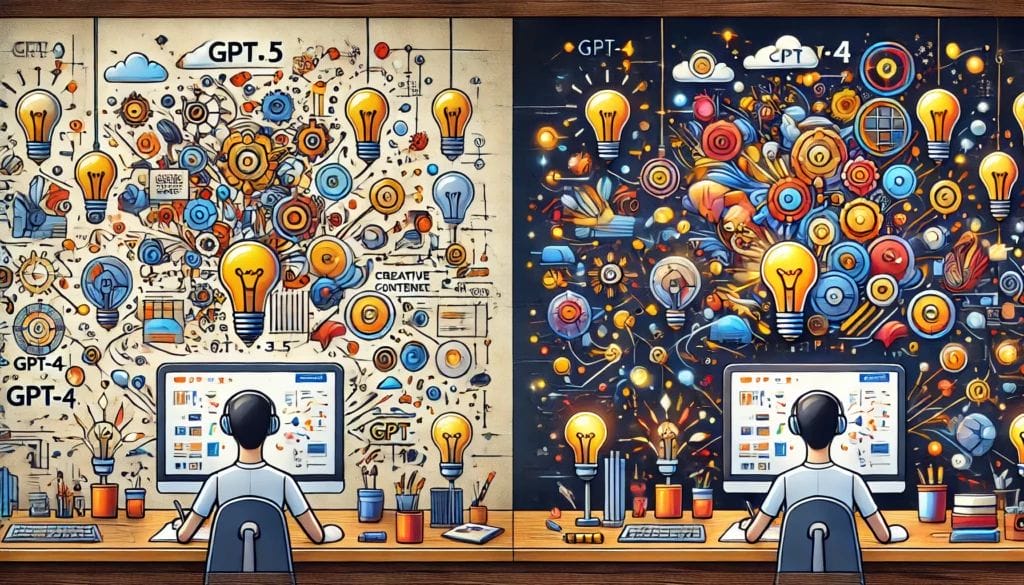
As discussed in the article, one can safely conclude that GPT-4 performs better than GPT-3.5 in content creation. It can create text with increased variety both in the lexical and linguistic domains and improved contextual fit. In addition, it can write coherent text across different genres and apply appropriate tones.
This makes it a better option for developers of multimedia content and developers of their blogs. Furthermore, its expertise in the style and pronunciation of certain aspects makes GPT-4 an incredibly helpful assistant for story writers and dramatists who depend on smooth and aesthetically appealing language.
Marketing and Advertising
In comparison GPT-3.5 vs GPT-4, specific advantages of GPT-4 are apparent in persuasive marketing. Companies whose enterprises embrace GPT-4 can create messages that create a deeper connection with the reader.
This model captures and interprets consumer information; thus, marketers have an easier time creating interstate strategies. Whether it’s generating optimized product description or a catchy advertising, GPT-4 provides in tune suggestions with the modern market.
Journalism
Journalism enjoys outstanding positive impacts from GPT-4 because it offers faster and more comprehensive evaluations of the events occurring. Its features assist in merging the collected data from different sources and using them to generate better and more complete answers than GPT-3.5.
Journalists can also use GPT-4 to write the first draft of recent occurrences in a news story or a summary of an article, or even angles journalists may take for a news story given some trends. This capability facilitates the improvement of the news coverage dimension and scope to foster an informed population in newsrooms.
GPT-3.5 vs GPT-4 Challenges and Ethical Considerations in Content Generation
Misinformation risks
Although the quality and generated content accuracy of the newer version – GPT-4 – have improved drastically, curbing false information remains a struggle. To the untrained eye, there seem to be improvements with GPT-4 in terms of its reasoning ability and to account for context, but this comes with the drawback of producing more realistic, yet, potentially false or misleading information.
Handlers of both GPT-3.5 and GPT-4 have to employ constructive criticism in determining the authenticity of the texts created by AI systems. Various methods involving saving the actual output and modulating the training data with enhanced approaches are necessary to manage the threats related to the generation of fake information.
Bias in generated content
Yet another prominent problem in artificial intelligence models and notably in GPT-3.5 and GPT-4 is incomplete information and inherent bias. We cannot overlook the problem at hand. Although GPT-4 further improves on general issues like more refined control over language nuances and less bias compared to GPT-3.5, the flaw persists. Here are several measures to consider when using GPT-4:
- Further, providing fresh and more extensive data for training, which would include a greater variety of opinions regarding the topics.
- There should be more elaborate specific measures put in place to eliminate bias from the generated content.
- Using techniques that will require a user to go through the text input at least once in a quest for bias, especially in cases where issues of ethnic sensitivity or religious sacredness are invoked in the input.
If we can address these concerns proactively, it will be possible to make proper use of the creativity of GPT-4 while avoiding the misuse of AI-generated content.
Conclusion: GPT-3.5 vs GPT-4 at the Forefront of Creative Content Generation
In conclusion, while analyzing the features of 3.5 vs GPT-4 iterations in detail one has to admit that GPT-4 has progressed in the result of GPT-3.5 particularly when we discuss making new content.
GPT-4 is a giant leap towards cognitive machine learning contrasting from the previous iterations where advancement was mainly in the optimization of the output of the next possible response and where context was just added to the value-added analysis.
Summing up, GPT-4 is much more flexible and innovative compared to prior versions – and this work is precisely why writers, marketers, and any content generation specialists would find GPT-4 to be a priceless tool to generate unusual and attention-catching stories.
It is also obvious over these advancements that GPT-4 will take the degree further by introducing a new benchmark for the creativity of the AI-authored content produced in the future. Over time, additional development incorporates human intuition and creativity along with AI capabilities generating exclusive value and possibilities in the digital story and content generation living space.