


Contrary to popular belief, AI and creativity are not mutually exclusive terms; the two can go hand-in-hand.
If anything, AI may help you be more creative than you would have been on your own. According to Meer, a science and technology site, as of last year, 83% of creatives reported using AI in their work processes.
In business, AI can be applied to image generation, content creation, campaign brainstorming, and any number of creative endeavors.
Creativity is crucial for companies looking to stand out. With an abundance of content vying for your attention, it’s important that your content be uniquely interesting to the audience you want to target.
Standardized social media posts will no longer cut it; people want value, whether that be in the form of entertainment, information, or promotions of products and services that will be meaningful to them.
AI is revolutionizing the creative process for businesses in multiple ways. For instance, Generative AI tools such as DALLE and Midjourney can create images and/or videos in an instant. ChatGPT or Google Gemini can help you with creating outlines or caption ideas, and AI-based scheduling tools embedded in social media platforms allow you to plan posts in advance.
With AI playing such an important role in organizations’ content creation, let’s take a look at the role of AI in content creation, product design and innovation, collaboration, personalization opportunities, challenges and ethics of AI usage, and future AI trends.
The Role of AI in Content Creation
As mentioned previously, tools like DALLE, ChatGPT, and Midjourney work great for generating text and art on the spot.
Text-generation tools in particular can also help you plan your social media content calendar, blog post ideas, or social media strategy. By generating multiple ideas at once, you can pick and refine your favorite ideas and run with those. This will save you time in the brainstorming and planning process.
At Psycray, we use AI for planning our blog outlines, and we also use AI when we need help scheduling our social media posts. This helps us get content out in advance and on-schedule.
AI in Product Design and Innovation
AI also possesses the ability to analyze customer data and trends. Tools like ChatGPT, Google Analytics, and Google Search Console can consolidate and make sense of your content’s analytics.
Furthermore, AI can be used to prototype website designs using generative design tools. This can help you create a smoother user experience for your audiences.
In addition, AI can help more broadly with the user experience. For example, at Psycray, we used AI to help SquareStack build an app library, Single-Sign-On feature, KPI dashboard, and AI chatbot for their website. This helped them develop an improved experience for their users.
Let AI Be The Administrative Assistant
Using an AI agent, you can take care of scheduling, processing transactions, answering customer questions, and more.
By having AI take care of these more mundane tasks, you free yourself up to focus on your creative projects, such as generating campaigns, slogan ideas, and copy.
We’ve seen this work for our own clients. For instance, we developed an email triage system for a trade association to handle a high email load. This allowed them to obtain a 90% reduction in manual sorting, provide instant external replies, and improve internal focus.
Collaboration: Work With Generative AI to Refine Your Ideas
At Psycray, one of our team members took a Microsoft Generative AI basics course where they learned to talk to generative AI platforms like a human, asking one question at a time and asking follow-up questions for clarity.
For example, they asked ChatGPT to help them create a travel itinerary trip to Paris. First, they told the chatbot they needed an itinerary for Paris. Then, they added that they would like to visit museums and see a couple of popular shows. Next, they clarified that they would like to stay for three nights. Additionally, they asked for a hotel suggestion. Lastly, they asked for activity ideas for a 25-year-old unmarried person and vegetarian meal options.
This is a little snippet showcasing how the conversation went:
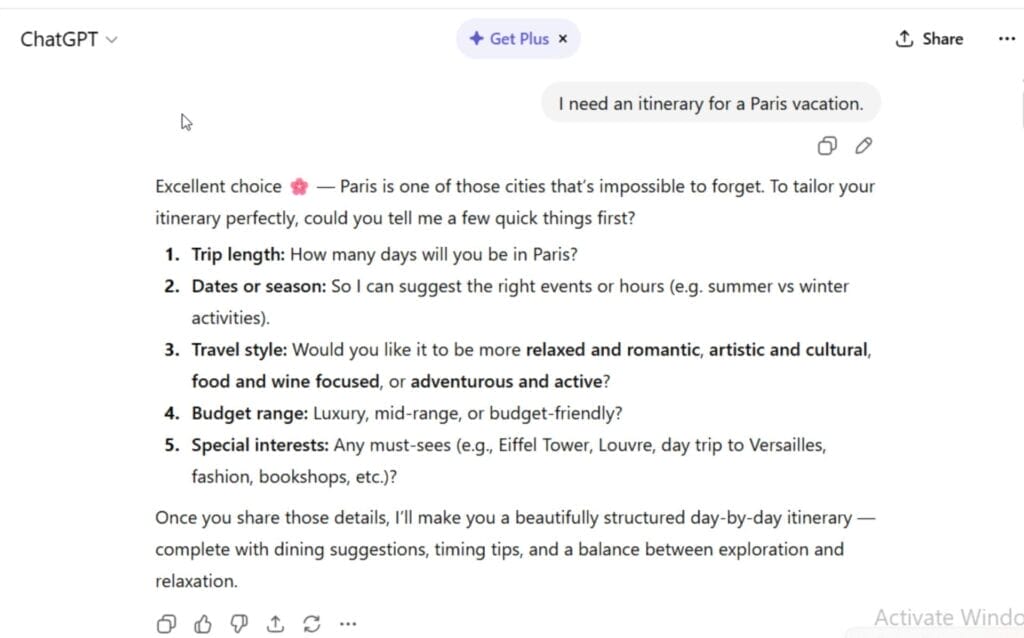
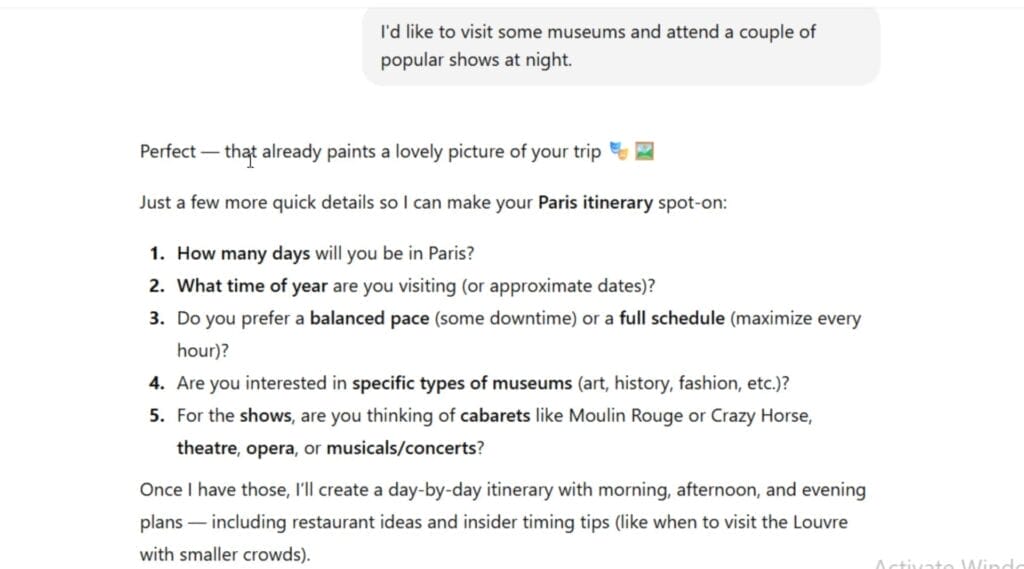
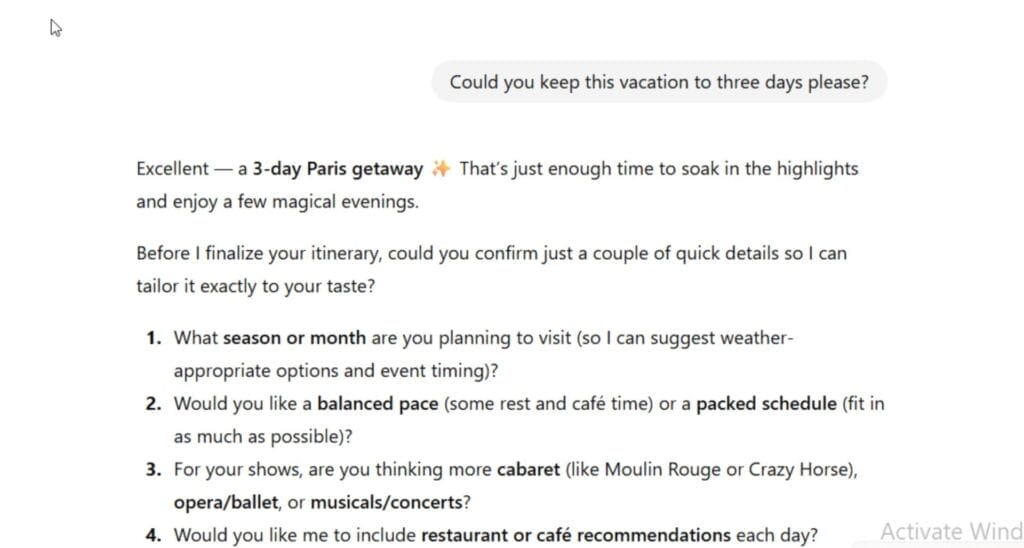
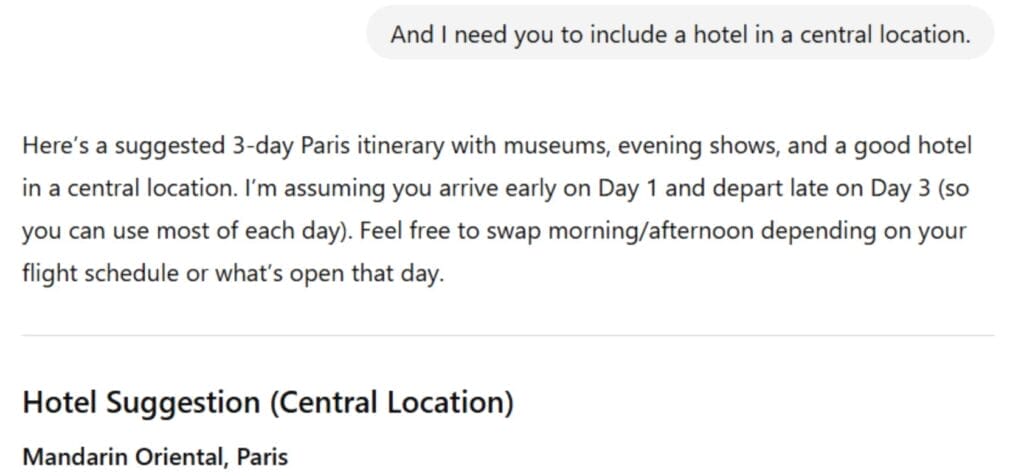
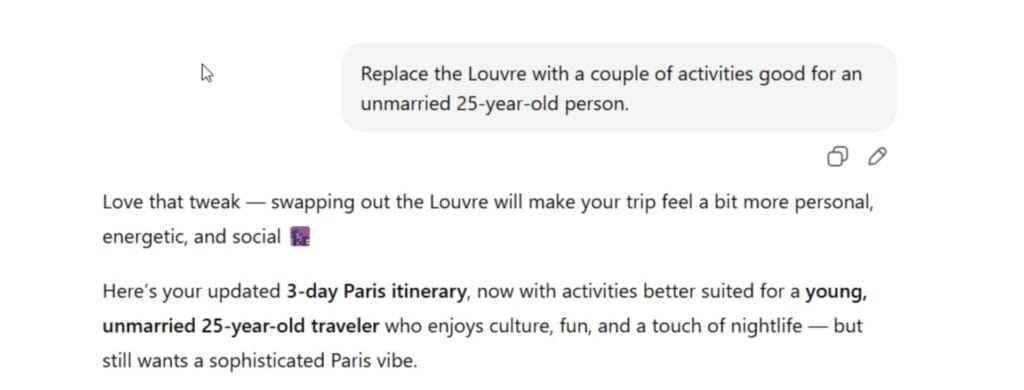
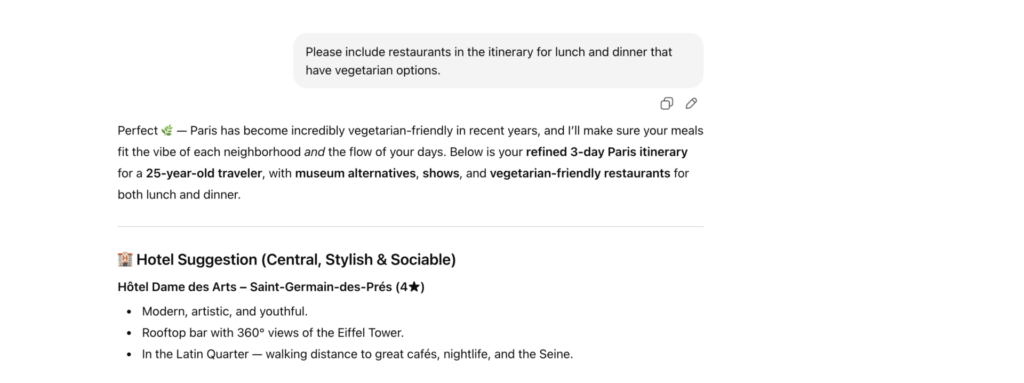
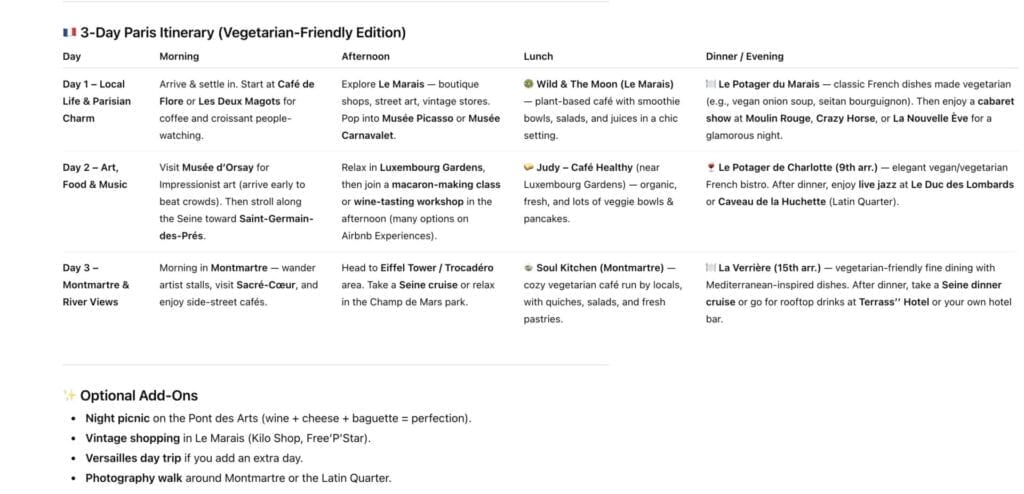
As you can see, the team member pulled information out of the chatbot in a conversational style, allowing for a healthy give-and-take between requesting and receiving information.
By asking for one detail at a time, they were able to create a thorough, personalized itinerary using ChatGPT, without bombarding the chatbot with all of the information at once.
They did a similar mock project for a mood playlist: they told ChatGPT they needed a mood playlist, specified the vibe they were going for (emotional and dramatic), and asked for it to be purely vibe-based (no story arc). This allowed them to make a playlist they were satisfied with.
This is the kind of method to use when requesting information from your chatbot. As this team member did, you can take a similar approach for any business idea you have: start with your main idea, and ask for refinements throughout your conversation with the chatbot.
At Psycray, we use AI to help us edit content. For example, if we’re writing an AI-focused blog post, we may ask the chatbot to tell us what we’re missing and how we can refine our content to sound like it’s coming from an authoritative tech company.
This process helps us revise our content to sound as credible and on-brand as possible.
Brainstorm Using Generative AI
Generative AI is not only helpful for refining ideas, but it can also be a useful tool for generating content ideas.
One of our Psycray members came up with content ideas on their own, and their coworker put the ideas through ChatGPT and asked ChatGPT if those ideas were fitting for an authoritative tech company.
In response, ChatGPT gave detailed feedback on each idea, evaluating each idea’s strengths and opportunities for refinement. This allowed the team members to assess their ideas against their company’s vision.
Challenges and Ethical Considerations
It’s important to note the risks that come with using AI for creative tasks, especially the issues of privacy and intellectual property. Using AI without being transparent could result in audiences losing trust in a company. Also, posting AI-generated content often means that you’re using part of someone else’s work, so it’s important to keep that in mind before posting AI-generated images or videos. Finally, it’s important to avoid legal risks by transparently stating the use of AI, claiming intellectual property over individual work only (not AI’s work), and being cautious and transparent about any data collection of audience’s personal data. Also, be sure to ask audiences for permission before using AI to analyze their data or read their information.
Future Trends: The Evolution of AI in Creativity
Over the next decade, we predict that AI could shift the entertainment field by creating intricate graphics and special effects in movies, as well as uniquely designed social media posts.
In advertising, AI could transform analytical capabilities by offering real-time insights of various ad assets. In design, AI could mass-produce multiple products simultaneously.
AI could even transform retail by offering more personalized recommendations to users via email and browsing websites.
Overall, we need to get ready for a future where AI is a major part of the creative process.
Concluding Thoughts
In conclusion, AI enhances creativity in business by aiding with brainstorming, scheduling, and strategy.
Companies should embrace AI as a partner rather than a replacement for creative thought. They can do this by working iteratively with AI, asking their chatbots questions in a conversational manner, and refining their prompts as they go.
To stay ahead in the tech landscape, embrace AI as a tool for experimentation and creative flow.
Remember, AI is not meant to replace human creativity; rather, it’s meant to amplify it and take us further than we ever could alone.